Current source gives packaged desktop builds a guarded account-free sample for inspecting fictional decisions and explanations without a private inbox. Its product data remains read-only; approve, reject, correct, and learn interactions run only in an isolated session-local simulation with no external effects. Published installers predate it.
0real accounts needed for the packaged local sample.
5 mintarget for the development or connected-account walkthrough.
1 cmddevelopment-only recorder path for screenshots, narration, and mp4 assembly.
Story spine
The demo is a trust arc, not a feature tour.
The storyboard spans two contexts: the packaged sample combines read-only product data with a separate non-persistent simulation, while connected-account and seeded development runs can exercise real product controls. Each scene states which context it requires.
01
Start with a safe way in.
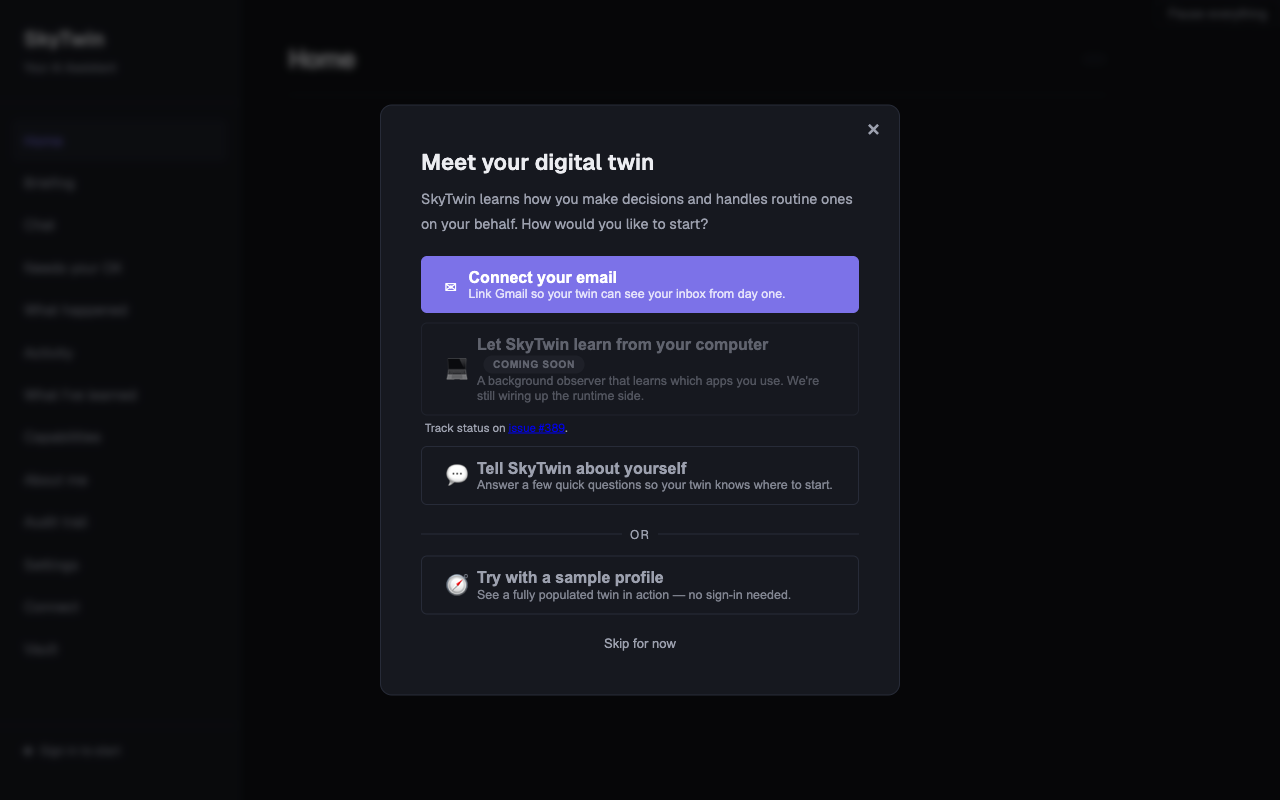
The first-run modal offers Google setup, a direct self-description path, and a sample profile. In packaged builds produced from current source, that sample is a short-lived, tab-scoped session: it safely shows populated read-only views and offers a separate isolated feedback simulation. Published installers predate this path.
02
Two things need you.
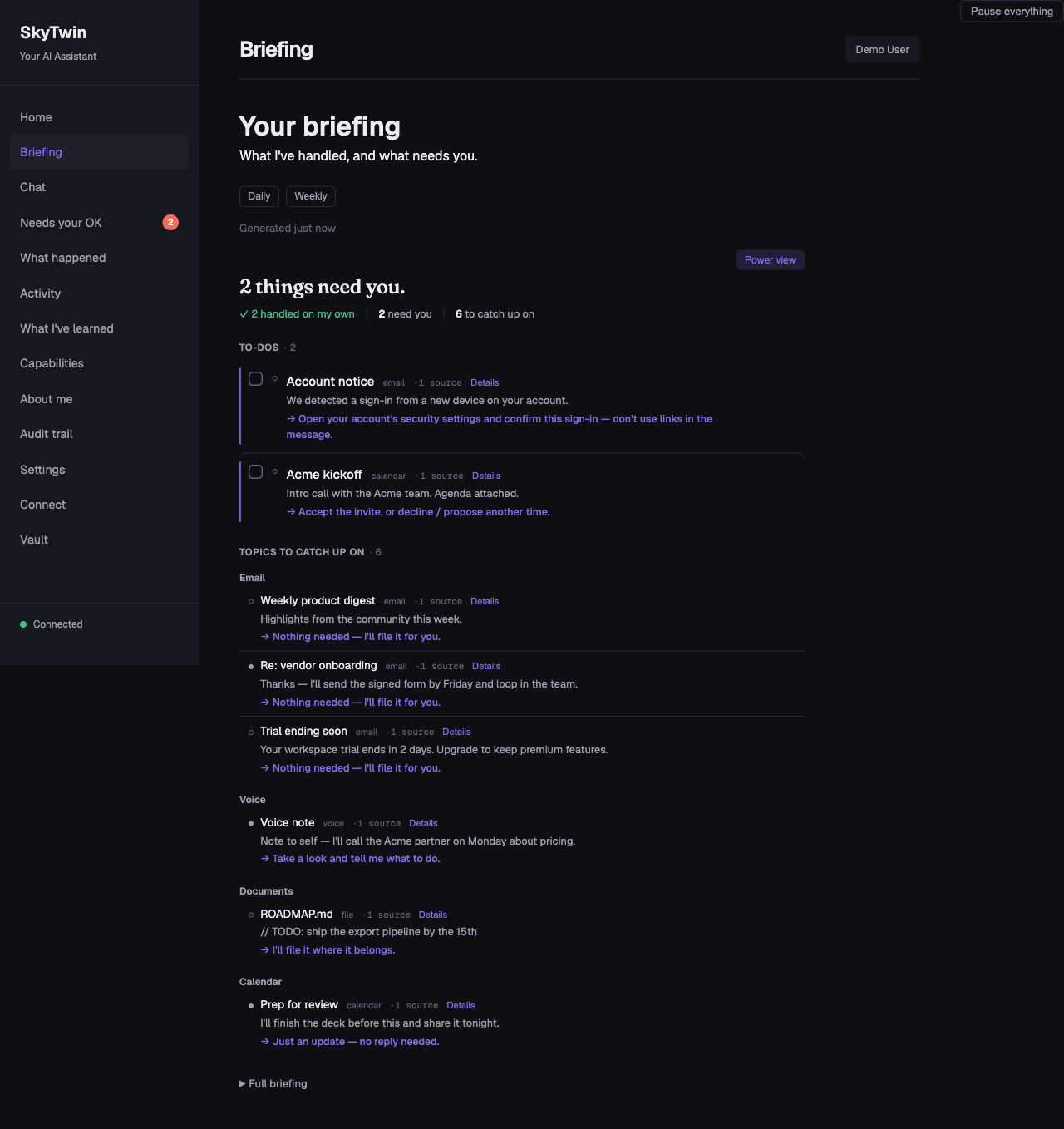
The briefing is the memorable surface. It separates action from awareness, shows what SkyTwin handled, and gives power users a path to inspect why.
03
Every approval carries its why.
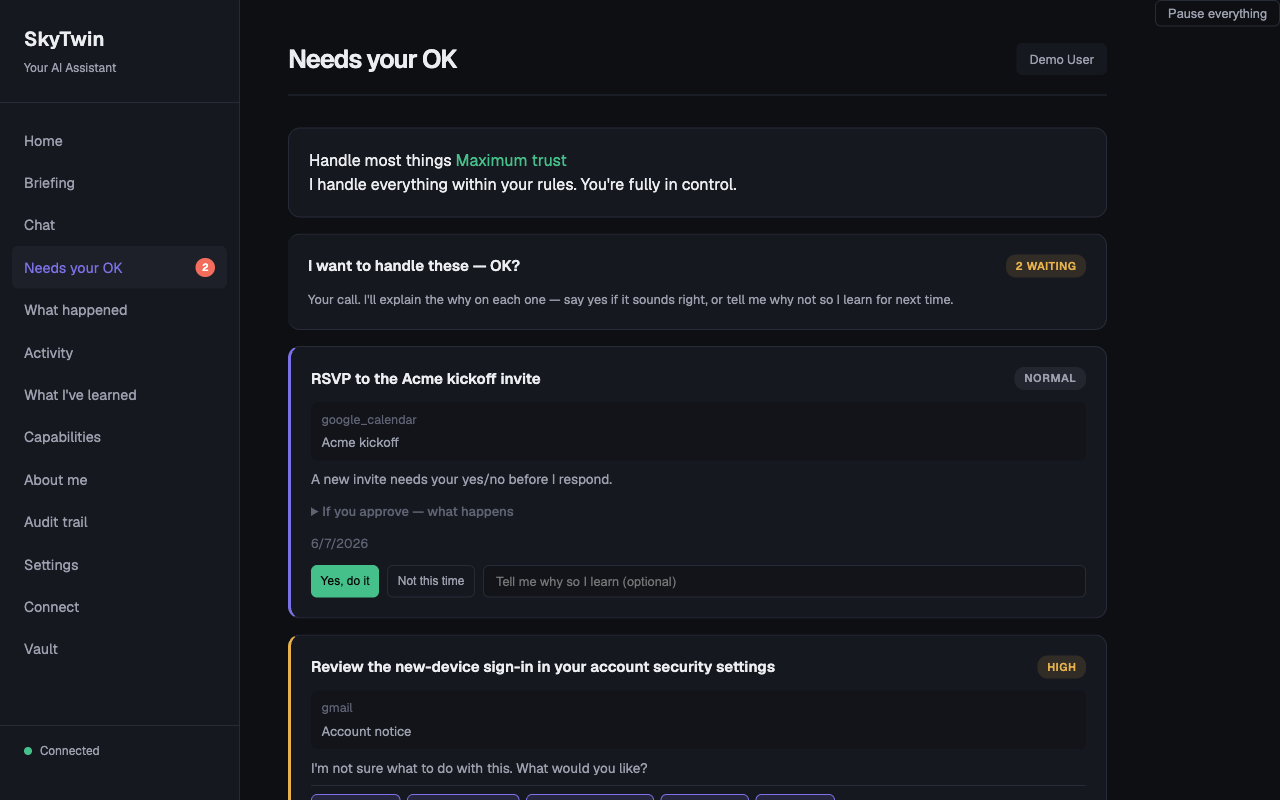
The pending-action screen is where the safety model becomes visible. The packaged sample can approve, reject, or correct fixed fictional proposals and inspect the policy and explanation result. Those interactions change only bounded session-local simulation state; they cannot persist feedback or reach a connector, credential, provider, or execution adapter.
04
Trust controls are not buried.
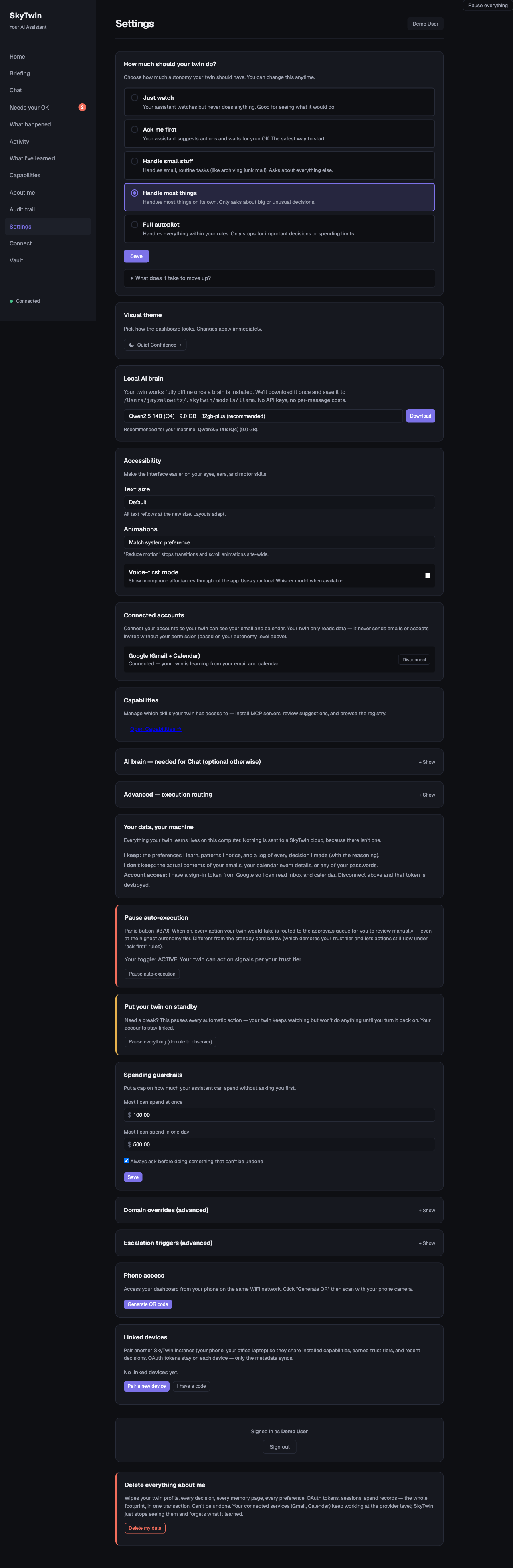
In a connected or seeded development run, Settings shows autonomy level, spend caps, credential status, connected accounts, and erasure controls. Settings is intentionally outside the packaged sample session's narrow read authority.
No-human render
Generate the launch video without screen recording.
The recorder drives the UI with Playwright, captures frames, synthesizes narration with local Piper TTS (via the app's own /api/voice/synthesize), and assembles an mp4 with ffmpeg. No API keys, no cloud — every dependency is local-first and open-source.
# one-time: install the standalone recorder + headless browser
cd scripts/demo
pnpm install --ignore-workspace
pnpm exec playwright install chromium   # ffmpeg must be on PATH

# render: boot the dev stack, seed the sample profile, record
pnpm dev      # terminal 1: API + worker + web
pnpm db:seed  # terminal 2: one-time per fresh DB
pnpm record   # narration via local Piper /api/voice/synthesize
Launch checks
What the demo must prove.
Cold load has a useful path. Current source can open an account-free packaged sample before OAuth; published installers do not include it yet.
The briefing knows the difference between act and FYI. The accent means attention, not decoration.
The sample explains without acting. It can simulate approve, reject, correct, and learn against fixed proposals, but no interaction persists or reaches an external effect.
Autonomy is inspectable in the full product. Connected or seeded development flows expose trust tiers, spend limits, credential status, pause, and delete; the packaged sample does not.